


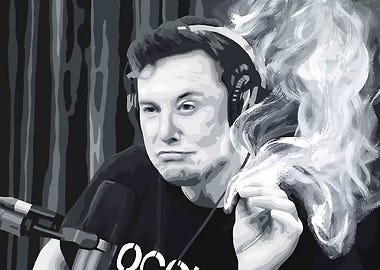
I began this week’s newsletter ready to talk about Elon Musk becoming the world’s first trillionaire. It’s been the topic on everyone’s lips, and I planned to break down the underlying mechanism that makes that altitude of wealth even possible — who sets executive pay, the levers for reining it in, the rampant state of income inequality in America.
I figured applying a finer lens would give you, dear reader, a better way to consume, discuss, and form opinions of your own. It’s what I’ve made a habit of doing in this space thus far, and I do think it’s valuable.
I fear it’s also completely out of touch with the reality of navigating endless information.
The mistake I’ve been making — in this newsletter and probably in how I think about information generally — is assuming the problem is quality. That if the breakdown is clean enough, well-sourced enough, efficiently packaged enough, something shifts for the reader. I’m not sure I believe that anymore.
For millennia, the densest form of learning was intergenerational transmission. The elder passed hard-earned wisdom down, and the recipient had inherent trust in that information, built over a lifetime. That was a clean exchange.
Today, the findings from a peer-reviewed study and a 15-second video technically start with the same odds of actually landing. Once something clears the attention threshold, its credentials don’t determine whether it crosses the blood-brain barrier. It’s whether it finds an emotion already waiting. Good media attaches itself to an emotion and rides that into your awareness, growing its roots in your perception from there. The variable isn’t the information itself but the lens you bring to it.
Which brings me back to Elon. A story like this — the world’s first trillionaire (built partly on government contracts, mind you) while a third of Americans can’t cover a $400 emergency — can land a lot of different ways depending on what it’s landing on. For some people it confirms a story they already carry: that the game is rigged, that nothing ever changes, and that the institutions meant to check this kind of accumulation have failed completely. I understand that read.
I just see it differently. Two things ground me when the news flow gets disorienting.
The first is that we’re living through an extraordinary period of disruption — witnessing the dissolution of the institutions, leadership styles, incentives, and assumptions that got us this far. Everything is in a constant state of evolution, and sometimes evolution looks shitty from the outside. The rise of a trillionaire, or a figure like Trump, strikes some as a signal of a society utterly lost. I don’t disagree. I just see it as a state of freefall before the next thing emerges. That’s a meaningful distinction.
Periods of great transition have happened before. The industrial revolution looked like the end of the agrarian world it was dismantling ,and in a lot of ways it was. What came after took generations to stabilize — and even if we’re not patient enough to hold that kind of long view right now, it’s still an honest one.
The second is simpler: I believe humanity is capable of solving the problems it has created for itself. Not naively — I’ve done enough reading to know how stuck most of these systems are. But I’ve also seen enough proof points to know that stuck doesn’t mean permanent.
Those two things make the Elon story less radioactive to me personally. They make it feel like the obvious conclusion of decades of incentives and policy choices. And as such, the information flows in and flows right out — no angry tweets required.
That’s what I mean by the lens being the work. The modern information problem is usually put on the user via painfully obvious advice— just seek better sources, resist the algorithm, don’t let yourself get duped. And I agree with part of that. But the refinement of your perception is a different kind of investment than the pursuit of the right outlets. Information is cheap now. A Claude or ChatGPT interface gives you infinite intelligence on demand. What isn’t cheap is the disposition you bring to it — what you believe about the world and what you’re oriented toward.
Sharpen that first, and the rest follows.
Stay up.
j.