


the nuance exists to help you rep your civic education at the speed of culture, in tight 5-minute reads every Friday. Because being an informed citizen takes a weekly practice.
I’m a big fan of Scott Galloway, and he’s mentioned this dynamic where older Americans are running up the national tab and putting it on “younger people’s credit cards”. Today, we dig into that claim.
The national debt conversation is something we hear about often, but we rarely dig into the actual mechanics driving it infinitely upwards. Let’s break it down.
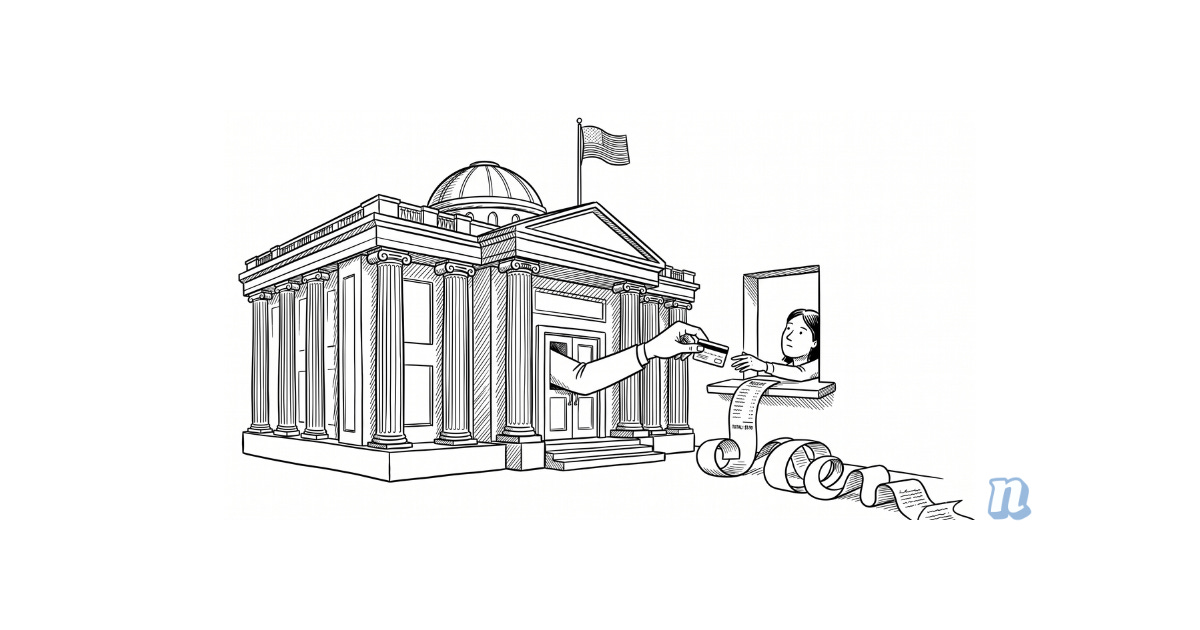
The federal government collects money every year via taxes. When it spends more than it collects, that gap is the deficit. If you add up every year’s deficit, you get the national debt, which just crossed $39 trillion. The deficit and national debt get used interchangeably, but they’re different things: the deficit is what’s happening right now, the debt is everything that’s already on our tab.
The U.S. has run a deficit in almost every year since 1970, with only a few exceptions in the 1990s. So this isn’t a recent crisis or a single administration’s failure, but rather a structural feature of how the government currently operates, and both parties have fed into it.
One take is that it’s a ticking clock: unsustainable borrowing that will eventually detonate into a real financial crisis. Another is that a country with its own currency can carry debt in ways a household can’t, and that deficit spending is sometimes the right tool to get things done
Both are partially true, which is what makes this hard to talk about in any absolute terms.
the mechanism underneath: how the government borrows
When the government spends more than it takes in, it has to cover that gap somehow. It does that by issuing bonds. A bond is basically an IOU where the government borrows money from an investor and promises to pay it back later, with interest.
Investors buy them because U.S. government bonds are considered the safest investment on earth. Foreign governments, retirement funds, and regular Americans all hold them.
That dynamic in itself sounds manageable until you get eyes on the interest bill. The U.S. now pays roughly $950 billion a year just in INTEREST on existing debt.
These numbers can be hard to contextualize, so for reference, that number exceeds the entire defense budget and dwarfs what the federal government spends on education, infrastructure, and children’s health programs combined.
Importantly, that money produces nothing. It doesn’t build roads or fund schools; it just services the government’s tab. And naturally, every year the tab grows, the interest grows with it.
the nuance
The deficit is a symptom, while the actual problem is more structural.
Federal spending comes in two forms: discretionary and mandatory. Discretionary spending is what Congress debates and votes on every year, think: defense, transportation, and education. Mandatory spending is what goes out automatically by law, regardless of what Congress does. Social Security, Medicare, and Medicaid fall into this bucket. Mandatory spending plus interest payments now eats up nearly all federal tax revenue.
So, the budget fights you see on the news are mostly about the much smaller discretionary slice. The programs actually driving the deficit are the ones almost nobody in office will touch, and for good reason. Thus, it’s a real pickle.
The risk isn’t so much that the U.S. goes broke, it’s that the budget gets squeezed to nothing
The government can’t “run out of money” the way a household can (it just continues to print more money). The real danger is what happens when interest payments eat so much of the budget that there’s no room left for anything else. Namely, the things average Americans care about: education, infrastructure, research, the investments that actually grow the economy and civic life over time.
This is a result of our system constantly rewarding spending now and deferring the cost to later
The last U.S. budget surplus was in 2001. Since then: multiple major tax cuts, two (now three) wars, a financial crisis, a pandemic, and spending increases across administrations of both parties. The deficit typically shrinks during economic booms and grows during downturns, but the underlying baseline has been getting worse for 25 years. Single-party blame gets us nowhere. Every political incentive points the same direction: spend now, bill later.
The interest rate problem is creating urgency
For years, the government borrowed on the cheap; low interest rates meant low debt payments. But now, those old, cheap bonds are expiring and rolling over into new ones at today’s higher rates. The weekly interest tab keeps climbing as that happens. At some point, and nobody can predict exactly when, the bond markets could start demanding even higher interest to keep lending to the U.S.
That’s the dangerous feedback loop that can turn a slow, manageable drift into a fast-moving problem. We haven’t hit it, but every year of inaction makes the eventual reckoning larger.
the real question
If every incentive in the political system (elections every two to six years, quarterly economic reports, news cycles measured in hours) is optimized for the short term, is the deficit a failure of the system? Or is it just working exactly as designed?
what this means for you
A big reason I draft this every week is because I, too, need the refresher on these big issues we’re always hearing about.
I’m a believer that the government exists to help solve major social problems. And this issue sits upstream of all of them; every debate about what gets funded or cut is downstream of this number. The disappointment people feel in the government’s output can trace back here.
Worth naming: the biggest drivers are Social Security and Medicare, programs that exist because people voted for them and that do real things for real people. In that way, the deficit isn’t purely waste.
The math on fixing it is straightforward but politically almost impossible: higher taxes, cuts to popular programs, or both. Neither version feels good. What you can do is learn to read the deficit as context underneath every political fight. And knowing that makes the noise easier to see through.
Stay up.
j
go deeper
See where federal money actually goes — The Congressional Budget Office publishes its annual budget breakdown in plain tables.
Track the deficit in real time — The Committee for a Responsible Federal Budget keeps an up-to-date tracker with plain-English context.
Understand how bonds actually work — TreasuryDirect explains what bonds are, who buys them, and how the process works.
If you want to go further — The Peter G. Peterson Foundation covers long-term fiscal projections with accessible explainers.