


nuance briefs exist to help readers think clearly and talk intelligently about a trending topic in 500 words or less.
Today’s topic: the social media verdicts everyone’s talking about.
what happened
A California jury found Meta and YouTube negligent for designing platforms that harmed a young woman’s mental health, awarding her $6 million in damages.
A separate New Mexico jury found Meta violated state child exploitation laws and ordered $375 million in civil penalties. Both companies are appealing. Thousands of similar cases are waiting in line.
the nuance
This wasn’t about what kids saw, it was about how the machine was built.
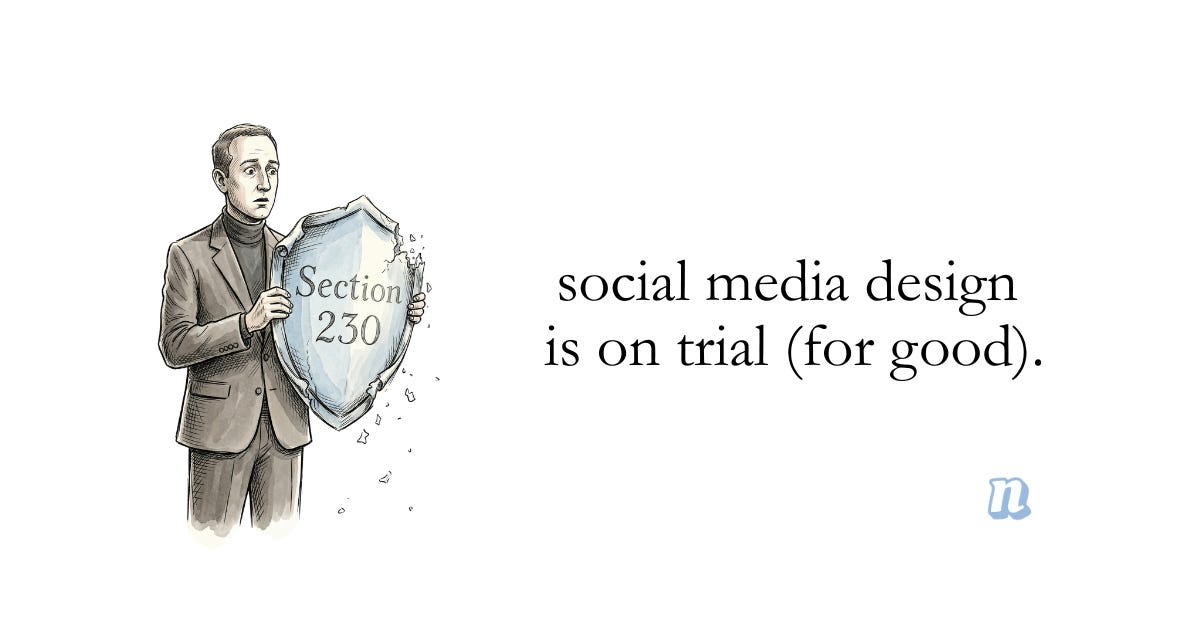
Section 230, the 1996 law that shields platforms from liability for user-posted content, has historically been the wall these cases run into.
This case got around it by targeting platform design itself — infinite scroll, autoplay, push notifications — the architecture engineered to keep you from stopping. It’s a new legal approach, and it worked.
The design-versus-content distinction is the whole ballgame
Meta’s defense — “teen mental health is complex and can’t be linked to a single app” — is true. But it’s also beside the point. The jury wasn’t deciding whether Instagram caused depression, it was deciding whether building a product designed to override a child’s ability to stop using it, without warning anyone, was negligent. Easier case.
$6 million isn’t the number that matters
Meta’s 2025 revenue was $200 billion, making the $6 million mostly symbolic. This was a bellwether — a test case whose outcome shapes thousands of cases still in the pipeline. The real exposure is orders of magnitude larger, and the companies know it.
think deeper than the headlines
Everyone’s calling this a Big Tobacco moment.
Between the lines: tobacco’s reckoning came when the legal losses compounded to the point where settlement was cheaper than fighting. It wasn’t a single verdict.
That took decades, a mountain of internal documents, and state attorneys general willing to spend years in court. All three of those conditions are now present for social media. So yes, the analogy holds — but if you’re using tobacco as your map, you’re looking at the beginning of a long road, not a turning point.
The deeper question is whether legal liability actually changes platform architecture or just becomes a cost of doing business. Tobacco companies paid billions and kept selling cigarettes. Will losing in court actually make the product different?
And if the architecture is the problem, what does a responsibly designed platform actually look like?
Nobody’s built it yet, in part because the incentives drive them to create the most engaging product possible. Cases like these could begin to shift those incentives, but there’s a long way to go.
j