


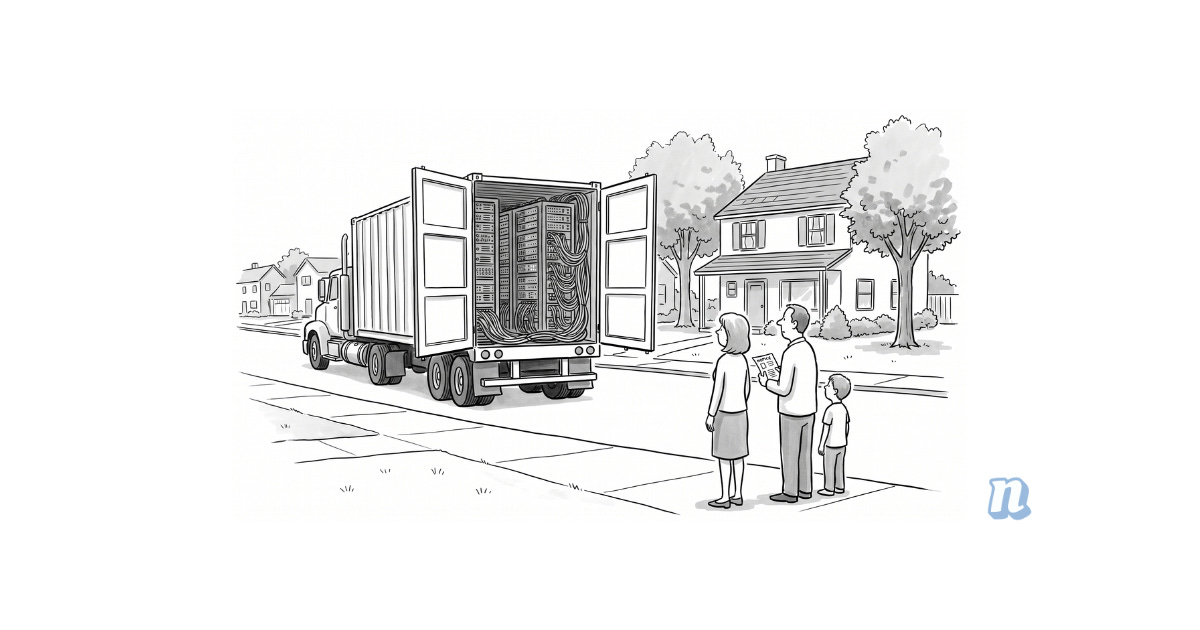
Data centers are heavy in the news cycle these days — let’s break down the backlash and what it means for you.
A data center is effectively just a warehouse full of server racks, but they’re best understood as the physical infrastructure behind everything digital: your Netflix streaming, your search, your social feed, and every AI tool you’ve used in the last two years.
They’ve always existed, but the AI boom turned data center builds into a full-on sprint, and communities across the US are now fighting to slow them down. One side of the debate says the pushback is NIMBYism (not in my backyard) that blocks critical American infrastructure. The other says people have a right to push back against massive companies that treat land, water, and power as theirs to take.
the mechanism underneath
When a tech company wants to build, it approaches local officials early, often under a non-disclosure agreement (NDA). Counties sign these to prevent competing towns from stealing the deal, which often promises huge tax revenue to the given town. From the POV of the mayor, for example, getting a data center could mean finally building that rec center or fixing the sidewalks.
This is all standard economic development practice. The problem is that by the time there’s a public process, there’s already a signed framework. So, the moment for real input came and went before residents really knew anything was going down. People find out a facility is coming the same way they’d find out about anything else — a job posting, a rumor, or a neighborhood group. By the time the public gets to weigh in, the deal is already done.
the nuance
The local concerns are valid and easy to quantify
A big data center can draw as much power as a small city and consume millions of gallons of water daily (servers get hot and need cooling). When that strains the local grid, everyone’s electric bill goes up. These are real costs landing on people who were never asked if they wanted to absorb them.
Moratoriums solve the wrong problem.
A moratorium (you’ll be hearing this word more often) is a temporary ban. Some states and towns are trying to pause all new data center construction while they figure out what to do. And I get the impulse, but banning it in one place doesn’t reduce the impact — it just moves it to wherever has less power to push back. The infrastructure is going somewhere.
The jobs are real but aren’t the full picture.
Data centers do create jobs — primarily in construction, which is legitimate but temporary. What doesn’t show up in the pitch to local officials is the other side of the ledger: grid upgrades, water system strain, road wear from construction traffic. Those costs land on the households and municipal budgets for years after. So yes, there’s a real economic case, but it’s often incomplete.
The fix already exists in some places.
A handful of states have passed laws requiring developers to pay for their own infrastructure costs and prove they’re not offloading expenses onto households, and it seems to work. Importantly, this means the choice isn’t “data centers vs. no data centers”…it’s about data center accountability.
the real question
The media will pitch this as an oversimplified question of to build or not to build. But here’s the deeper question: When private infrastructure like this serves a national purpose but imposes local costs, who gets to decide how it plays out? And at what point in the process does public input actually matter?
what this means for you
I think about this issue the way I think about a lot of modern conveniences — whether that’s AI, fast fashion, a cheap burger, or bottled water. While the convenience and value is real, the negative externalities are often hidden from my experience. I don’t see the industrial farm, or the river running with dye from a textile plant, or the landfill. I enjoy the product without seeing any of that. But at the end of the day, someone else lives near it.
The data centers conversation is different because we’re watching it happen. The community meetings are on the news and the grid strain is showing up on electric bills in real time.
That’s worth something. Awareness doesn’t fix anything on its own, but you can’t push back on what you can’t see. The people in these community meetings figured out the process, showed up, and in a lot of cases actually stopped projects or changed the terms (learn more below). That’s the civic muscle this newsletter hopes to help you build.
You don’t have to live next to a proposed data center for this to matter. But it helps all of us to know the mechanics, so when something does land in your backyard, you’re not starting from zero.
Stay up.
j
go deeper
Find out which projects are proposed near you — Heatmap tracks contested and canceled data center projects nationwide
See what accountability legislation actually requires — The Sierra Club’s 2026 Data Center Policy guide breaks down what good state laws look like in plain language
Track the federal transparency push — A bill introduced in early 2026 would require public reporting on energy and water consumption nationwide.
Get the state-by-state picture — MultiState tracks every data center bill across all 50 states.