


the nuance exists to help you rep your civic education at the speed of culture, in tight 5-minute reads every Friday. Because being an informed citizen takes a weekly practice.
I often find myself in conversations about how expensive modern life is, especially housing. Whether you own, rent, or don’t care, it’s worth it for all of us to understand the basic mechanics underlying the housing affordability crisis.
One side says the market is broken and we need government to step in with things like rent caps, subsidies, and public housing. The other says government is the problem, with zoning laws and red tape strangling our ability to build housing at the pace we need to.
This is a quick breakdown to help you think more clearly about what’s actually happening in an issue that impacts everyone.
the context
The U.S. housing shortage stood at over 4 million homes in 2025. To put that in context: it’s roughly the entire housing stock of New York city (give or take).
Prices nationwide are up roughly 25% since the pandemic, and Millennials now make up 38% of families “doubling up” with nonrelatives (sharing homes with people they’re not related to) because buying or renting alone is increasingly out of reach.
There’s a book called Abundance (Ezra Klein + Derek Thompson) that put housing supply at the center of a national conversation about why America just seems structurally unable to build its way out of this. That’s what brings me here today.
the levers — what’s actually being debated
Before we get into the nuance, it helps to know what the actual tools are for making housing more affordable:
Supply (aka build more units).
More homes mean more competition between sellers and landlords, which lowers prices for you and me over time. This is the YIMBY argument (Yes In My Backyard), and the evidence behind it is strong.
Zoning reform
Most American cities legally prohibit dense housing in most of their land area. Single-family zoning means you can’t build an apartment where a house sits, even if demand is high. So, changing that is one of the most direct paths to unlocking the supply problem.
Rent control / stabilization
We hear about this one a lot, especially from the Progressive side. Think of these as caps on how much landlords can raise rent. It’s politically popular because it protects people in units right now, but the economics on long-term effects are a lot messier (more on this below).
Direct subsidies
Government funding for explicitly affordable units, usually through programs like Section 8 or low-income housing tax credits. These try to fill the gaps the market can’t (or won’t).
None of these are mutually exclusive, and some version of each is at play across the US.
Onto the debate.
The binary
SIDE 1: “We need rent control and affordable housing mandates”
This argument goes something like: the market is failing people right now, with real families being displaced and struggling.
When rents rise 20% in a year, telling someone “yo, just wait for supply to catch up” isn’t an acceptable answer. Life often moves faster than macroeconomics. And so, government has an obligation to protect people who can’t compete in a broken market. And the private market will never voluntarily build for low-income households.
SIDE 2: “Government is why this is expensive in the first place”
Every unaffordable city is drowning in zoning restrictions, permitting delays, and neighborhood veto power. San Francisco spends $700k per affordable unit it builds. Meanwhile, Houston has minimal zoning and some of the most stable rents in the country. This argument says just get out of the way, let people build, and prices will come down. Also, if you oppose new construction in your neighborhood (aka NIMBYs) you don’t get to complain about rent.
the nuance
the supply gap is so large that building alone won’t close it fast, but it’s still the right direction
We’ve been underbuilding since the 2008 financial crisis cratered the construction industry, and it never fully recovered. Even in a record year for homebuilding (2023) the deficit grew, because a couple million new families formed while only 1.4 million new homes were added. So, the gap continues to widen.
That’s the big case for zoning reform: unlock more land, allow denser construction, get more units into the pipeline. Bummer is, zoning reform typically works on a 10-to-20-year timeline: you change the law, developers plan, permits get issued, buildings go up. We can do a lot better here.
rent control helps the people already in units but tends to hurt everyone else
This is the uncomfortable one. While rent control appears to help current tenants in the short run, in the long run it decreases affordability, fuels gentrification, and creates negative spillovers on the surrounding neighborhood.
When you cap what a landlord can charge, they have less incentive to rent. A Stanford study of San Francisco found that rent control caused landlords to reduce rental supply by 15% – and that the resulting shortage drove rents up 5% citywide, costing renters an estimated $2.9 billion in total. The people who rent control fails most are the ones trying to find a place to move into.
the blocker is engagement and who shows up
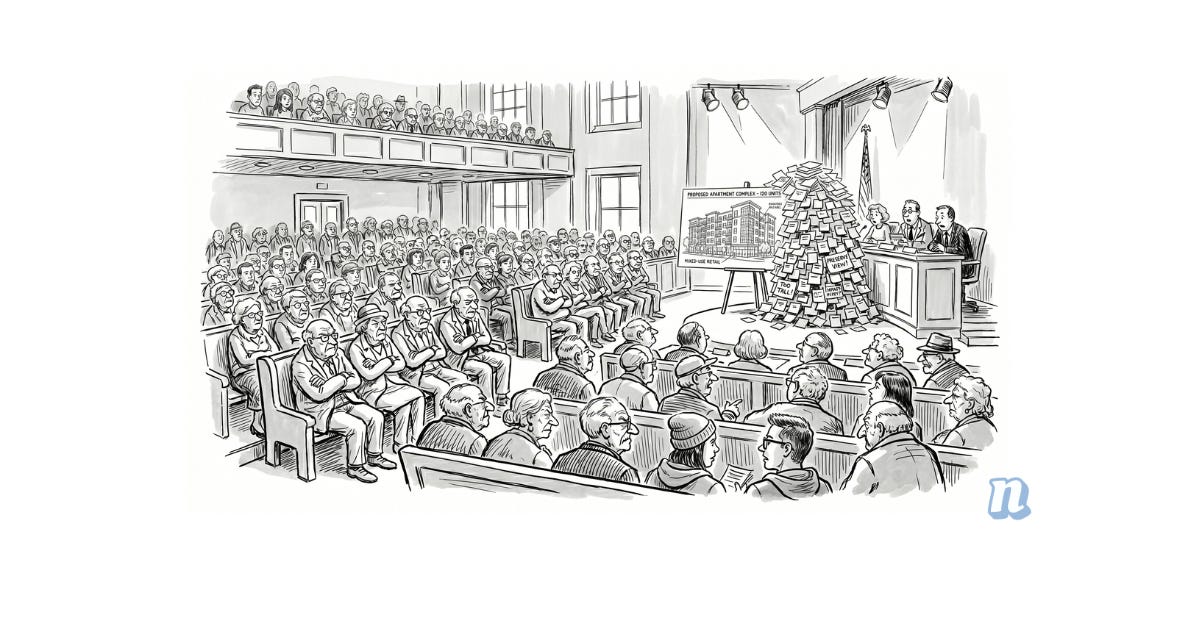
Zoning reform dies at city council meetings because homeowners show up, and future residents don’t.
If you take one thing from this newsie, let it be this dynamic: Homeowners have a direct financial stake in a limited supply because scarcity makes their house more valuable.
Meanwhile, renters and people who want to move to a city have no seat at the table because they don’t live there yet. The political structure of local government systematically advantages the people who benefit from the status quo. And they’re a particularly loud bunch.
the real question
If we've known the solution for decades and still haven't done it, what does that say about who we've decided housing is really for?
what this means for you
Housing, like so many defining issues right now, is a question of individual vs. collective responsibility. And it’s hard. As a homeowner myself, I completely understand the draw to protect the value of my investment. I make sacrifices, I have my own worries about providing for my family, and I want a return on what I purchased. So it’s not like this is easy. It’s easy to judge the NIMBY types — but I get it.
Ultimately it’s a values question. A matter of putting the collective benefit of affordable housing ahead of your own financial situation. Which might seem like a big ask…but is it, really? Only you can run the math on how much a new development would actually affect your life. Most research suggests the impact on surrounding home values is modest, often a few percentage points at most. If that's the tradeoff, I think it's worth it.
This issue forces us to reckon with what we’re actually willing to give up for the whole. That’s why it’s worth engaging with. Plus, most of us have people in our lives who are struggling to afford a home. That’s reason enough.
Stay up.
j
Think for yourself.
j.
Go deeper
See where the shortage is worst — Up for Growth’s Housing Underproduction report maps the deficit city by city: upforgrowth.org
Read what the rent control evidence actually says — Brookings has the clearest synthesis: brookings.edu
Watch what Minneapolis did — they eliminated single-family zoning citywide and rents measurably stabilized; it’s the closest U.S. proof point we have
Read the book driving the policy conversation — Klein and Thompson’s Abundance is the intellectual foundation for the supply-side push right now
Flag: Go Deeper links 1 and 2 are verified. Link 3 — Minneapolis 2040 is real policy, but surface a primary source URL before publishing. Link 4 is a book, no URL needed.